The House of Saul and the Songs of David


A prophetic editorial for a noisy age

A sobering pattern in Scripture keeps resurfacing in the modern worship debates. This is especially true when scandals erupt. During these times, voices rise to condemn entire ministries. It is the pattern of Saul’s house. It is impressive, polished, and anointed in the eyes of the people. It is also the pattern of David, the shepherd‑psalmist whose songs carried healing into a broken court.

Why This Conversation Matters Now

In recent years, well‑known ministries such as Bethel, Hillsong, and Elevation have faced intense public scrutiny. Some of that scrutiny has been justified, some exaggerated, and some weaponized. What began as accountability has, in many circles, turned into a movement. This movement seeks to discredit not only the leaders who failed. It also discredits the worship, the songs, and the sincere believers who served faithfully within those houses. This article is not written to defend institutions. It is written to defend the Davids—those who ministered with purity in places where Saul’s fell. It also aims to remind the church that while God judges leaders, He also preserves worship. This is not a theoretical argument. It is a response to a spiritual battle raging right now.

The People’s King and the Shepherd’s Song

Saul embodied everything Israel believed a leader should be. “A choice young man and a goodly: there was not among the children of Israel a goodlier person than he” (1 Samuel 9:2). Yet beneath the appearance, something was breaking. His disobedience became rebellion, for “rebellion is as the sin of witchcraft, and stubbornness is as iniquity and idolatry” (1 Samuel 15:23).

Into that compromised house, God sent a boy with a harp. Scripture says, “David took a harp and played… so Saul was refreshed, and was well, and the evil spirit departed from him” (1 Samuel 16:23). While Saul unraveled, David worshiped. While Saul threw spears—“Saul cast the spear; for he said, I will smite David even to the wall” (1 Samuel 18:11)—David refused to return them.

David ministered instead of weaponizing his gift.

The Modern Sauls and the Modern Davids

Today, the failures of large ministries often become the feeding ground of self‑appointed critics. They gather like the Pharisee in Jesus’ parable, who prayed, “God, I thank thee that I am not as other men are” (Luke 18:11). They forget that Saul was anointed too. God placed him on the throne. David served faithfully in a spiritually sick environment.

David’s songs were born in a broken house, not a perfect one. His worship rose from places like, “The Lord is my shepherd; I shall not want” (Psalm 23:1) and “Create in me a clean heart, O God” (Psalm 51:10). To attack every worship song because of the failures of a leader is to confuse Saul with David. It is to condemn the harpist because the king lost his way.

The Sin of the Sword‑Bearer

There is a dangerous arrogance in believing that God needs human outrage to accomplish His justice. David understood that judgment belongs to God alone. When Saul hunted him, David said, “I will not put forth mine hand against my lord; for he is the Lord’s anointed” (1 Samuel 24:10).

There is another moment in Scripture that exposes this same spirit. When the mob came to seize Jesus, Peter drew his sword and struck the servant of the high priest, cutting off his ear. But Jesus immediately rebuked him: “Put up thy sword into the sheath” (John 18:10–11). Peter believed he was defending the truth. He believed he was protecting the Kingdom. But in his zeal, he wounded the very one Jesus intended to reach—and Jesus healed what Peter’s sword had damaged. Many today are repeating Peter’s mistake, cutting off ears in the name of righteousness and silencing the very people God is still pursuing.

Paul echoes the same truth: “Vengeance is mine; I will repay, saith the Lord” (Romans 12:19).

Because David refused to take God’s job, God gave David the kingdom. “So all the elders of Israel came… and they anointed David king over Israel” (2 Samuel 5:3).

The Scandals Are Real—But So Is the Pattern

Yes, the sins of modern Sauls are being exposed. Yes, God is humbling what needs to be humbled. “To every thing there is a season… a time to break down, and a time to build up” (Ecclesiastes 3:1,3). But in the midst of that shaking, there are Davids—songwriters, worship leaders, musicians—who served faithfully in those houses. And God is still near to them, for “the Lord is nigh unto them that are of a broken heart” (Psalm 34:18).

To crucify them because Saul fell is to repeat the error of the Pharisee who mistook indignation for righteousness. Jesus warned, “Judge not, that ye be not judged” (Matthew 7:1).

Let God be God.

A Final Admonition

Unless we are sinless, it is not wise to cast stones or spears at another whom God may be preparing to raise up. Jesus said, “He that is without sin among you, let him first cast a stone” (John 8:7). And James reminds us, “There is one lawgiver, who is able to save and to destroy: who art thou that judgest another?” (James 4:12).

The call of this moment is not to sharpen swords but to sheath them. Not to condemn but to discern. Not to destroy but to wait. Not to exalt ourselves but to humble ourselves. “Let all bitterness… be put away from you” (Ephesians 4:31) and “in lowliness of mind let each esteem other better than themselves” (Philippians 2:3).

The God who removed Saul is the same God who raised David. “Promotion cometh neither from the east, nor from the west… but God is the judge” (Psalm 75:6‑7). And Christ Himself “committed himself to Him that judgeth righteously” (1 Peter 2:23).

The Final Word

In an age of noise, outrage, and digital stones, the church must remember the lesson Jesus taught: “Blessed are the meek: for they shall inherit the earth” (Matthew 5:5). And again, “He that humbleth himself shall be exalted” (Luke 18:14).

Let the Sauls fall if God wills it.
Let the Davids rise when God appoints it.
Let the songs continue to minister.
Let the swords remain sheathed.
Let God be God.

“Trust in the Lord with all thine heart… and He shall direct thy paths” (Proverbs 3:5‑6).
“All things work together for good to them that love God” (Romans 8:28).

Worship in Spirit and Truth: A Call Back to the Heart of God


Worship has always been at the center of God’s relationship with His people. Yet, it is one of the most misunderstood realities in the modern church. We often reduce it to music or structure. Sometimes, it’s even reduced to atmosphere. We forget that Scripture presents worship not as a formula to follow. Instead, it is a life awakened by the presence of God. The clearest definition we have comes from Jesus’ words to the Samaritan woman. “The hour is coming, and is now here. The true worshipers will worship the Father in spirit and truth. For the Father is seeking such people to worship Him” (John 4:23). In that single sentence, He dismantles every man‑made system and calls us back to the heart of worship. What follows is a return to that simplicity—ten truths that shape what true worship really is.

1. Worship Begins With God’s Revelation, Not Our Initiative

Every genuine act of worship in Scripture begins with God making Himself known. Abraham responds to God’s voice (Genesis 12:1). Moses removes his sandals because God appears in the burning bush (Exodus 3:4–5). Isaiah cries, “Woe is me,” only after seeing the Lord high and lifted up (Isaiah 6:1–5). Worship is always a response to revelation. We do not start worship; God does. He speaks, He reveals, He draws—and we answer. This is why Jesus says the Father is seeking worshipers, not worship. God desires hearts awakened by His presence, not people performing religious duties.

2. Worship Is Spiritual Before It Is Structural

Jesus’ declaration that “God is Spirit” (John 4:24) means worship cannot be confined to buildings, rituals, or formulas. In the Old Covenant, worship was tied to a place—the Temple. In the New Covenant, worship is tied to a Person—the Holy Spirit. Paul reminds us that we “are the temple of the Holy Spirit” (1 Corinthians 6:19). Worship is no longer about sacred architecture but about a Spirit‑filled life. The Spirit animates, breathes, convicts, comforts, and leads. True worship is alive because the Spirit is alive within us.

3. Worship Is Truth Before It Is Technique

Truth is not merely doctrinal accuracy; it is reality as God defines it. Jesus Himself is “the way, the truth, and the life” (John 14:6). To worship in truth is to align our hearts with who God is and who we are in Him. It means rejecting pretense, performance, and self‑deception. David prayed, “Behold, You delight in truth in the inward being” (Psalm 51:6). Worship in truth is honest, humble, and anchored in the revelation of God’s character. It is not about doing the right things in the right order. It is about standing rightly before the God who sees all.

4. Worship Is Surrender, Not Performance

The first time the word “worship” appears in Scripture is when Abraham prepares to offer Isaac. He states, “I and the boy will go over there and worship” (Genesis 22:5). Worship is sacrifice. It is yielding our will, our pride, our preferences, and our plans. Paul urges believers to present their bodies as a living sacrifice. He indicates this is your spiritual worship (Romans 12:1). Worship is not about how well we sing or how deeply we feel; it is about how fully we surrender. The heart bowed low is the truest instrument of praise.

5. Worship Is Participation, Not Observation

In the Temple, worship was performed by priests on behalf of the people. But in Christ, every believer becomes a priest (1 Peter 2:9). Worship is no longer a spectator event. Paul commands the church to “speak to one another in psalms, hymns, and spiritual songs” (Ephesians 5:19). Worship is congregational, participatory, and mutual. It is the gathered people of God lifting one voice, one heart, one confession. When worship becomes a performance to watch rather than a sacrifice to offer, it ceases to be worship at all.

6. Worship Is a Life Offered, Not a Moment Experienced

Paul’s call is to present our bodies as living sacrifices (Romans 12:1). It reframes worship as a lifestyle, not a segment of a service. Worship involves obedience on Monday. It requires purity on Tuesday. On Wednesday, it means showing mercy. Generosity is emphasized on Thursday. Forgiveness follows on Friday. Finally, rest is paramount on Saturday. The songs we sing on Sunday are the overflow of the lives we live throughout the week. Jesus rebuked those who honored Him with their lips while their hearts were far from Him (Matthew 15:8). True worship is not measured in moments but in a life aligned with God.

7. Worship Is Encounter, Not Engineering

Throughout Scripture, worship erupts when God reveals Himself. His glory fills the Temple (2 Chronicles 5:14). His presence shakes the thresholds (Isaiah 6:4). His Spirit falls like fire in the upper room (Acts 2:1–4). These moments cannot be manufactured. They cannot be scheduled, scripted, or controlled. Elijah prepared the altar, but only God could send the fire (1 Kings 18:38). True worship prepares the heart and waits for God to move. It is not about creating an atmosphere; it is about welcoming the King.

8. Worship Is the Recognition of God’s Worth

The English word “worship” comes from “worth‑ship”—the act of declaring God’s worth. The elders in Revelation fall down and cry, “Worthy are You, our Lord and God” (Revelation 4:11). Worship is the soul’s recognition of God’s infinite value. It is the moment when everything else fades and only His glory remains. Whatever we value most, we worship. Jesus warns that we cannot serve two masters (Matthew 6:24). Worship is the reordering of our loves until God is supreme.

9. Worship Requires the Right Garment

Scripture often connects worship with garments. Priests wore holy garments (Exodus 28:2). Isaiah saw filthy garments replaced with clean ones (Isaiah 61:10). Jesus spoke of wedding garments in His parable (Matthew 22:11–12). Paul tells believers to “put on Christ” (Romans 13:14). The garment of worship is not fabric but heart posture—humility, repentance, purity, and gratitude. God resists the proud but gives grace to the humble (James 4:6). Worship begins when we dress the heart in the righteousness Christ provides.

10. Worship Is God’s Presence Resting on God’s People

The essence of worship is simple: God is here, and we respond. Moses refused to move without God’s presence, saying, “If Your presence will not go with me, do not bring us up from here” (Exodus 33:15). David longed for the courts of the Lord because God dwelled there (Psalm 84:1–2). The early church gathered because the Spirit was among them (Acts 4:31). Worship is not about the right order, the right elements, or the right structure. It is about the right God meeting the right heart. When His presence rests on His people, worship becomes inevitable.

A Final Word for Worship Wednesday

True worship is the living, Spirit‑led, truth‑aligned response of a surrendered heart to the revealed presence of God. It is not a formula to master but a relationship to embrace. It is not a structure to defend but a Person to adore. It is not a moment to engineer but a life to offer. May we be the worshipers the Father seeks. We should worship in spirit and in truth. Our hearts should be awakened, our lives surrendered, and our eyes fixed on the One who is worthy.

Gratitude As a Transforming Posture


Gratitude is more than a polite response to good news. It is a posture that reshapes the heart long before circumstances shift. Scripture consistently shows that gratitude is meant to be practiced in the in-between. It should be practiced in the sowing. It should be practiced in the waiting. It should be practiced in the quiet seasons where nothing seems to be moving.


1 Thessalonians 5:18 “In everything give thanks; for this is the will of God in Christ Jesus for you.”


This command doesn’t wait for outcomes. It calls for gratitude in everything, not after everything.
There is a reactive gratitude that thanks God for what He has just done. But there is also a forward‑leaning gratitude. It honors God for who He is, even when the field still looks barren. This kind of gratitude is not denial; it is alignment. It anchors the heart in God’s character rather than in visible results.


Psalm 136:1 “Give thanks to the Lord, for He is good; for His mercy endures forever.”


Notice the reason for gratitude: His goodness and His mercy—not our circumstances.
When gratitude becomes a rhythm instead of a reaction, it changes the way people walk through uncertainty. It steadies the emotions. It guards the mind from cynicism. It keeps the spirit open instead of closed. Gratitude prepares a person to receive without pride and to endure without bitterness.


Colossians 3:15 “And let the peace of God rule in your hearts… and be thankful.”


Peace and gratitude are linked. Gratitude creates the inner environment where peace can rule.
And here’s the quiet truth: gratitude often becomes the bridge between seasons. It doesn’t force outcomes, but it creates the inner space where faith can breathe. It turns waiting into worship. It turns delay into formation. It turns ordinary days into sacred ground.


Hebrews 12:28 “Let us have grace, by which we may serve God acceptably with reverence and godly fear.”


The phrase “let us have grace” can also be rendered “let us be thankful”—showing that gratitude empowers acceptable worship.


Gratitude is not a finish line. It is a way of moving through the world. It involves trusting God more than the calendar. You trust more than the numbers. You trust more than the silence. It is the steady heartbeat of a life rooted in faith.

Snowmageddon and the Storms We Create: When the World Mobilizes and the Church Retreats


The forecasts grow louder. The graphics turn dramatic. The region braces for what the news has christened Snowmageddon. This is a storm wrapped in apocalyptic language. It comes complete with countdown clocks, urgent tickers, and warnings that feel more cinematic than meteorological. The world prepares with a kind of frantic determination. Meanwhile, something else unfolds quietly in the background. It is almost unnoticed unless you are paying attention.

Electric linemen are already staged in their trucks, engines idling, ready to restore power the moment the first line snaps. Road crews sit in warm garages beside mountains of salt, waiting for the call to roll out into the night. Grocery stores are stripped bare as shoppers fill carts with enough food to survive a siege. Everyone is mobilizing. Everyone is preparing. Everyone is stepping into their role with a sense of duty and resolve.

And then, amid all this activity, comes the announcement from the one place that claims to carry the unshakable Kingdom:

“All services are canceled due to inclement weather.”

The contrast is hard to ignore. The world gears up. The church shuts down.

This is not about recklessness or ignoring safety. It is about the symbolism—the quiet confession embedded in the decision. When the world anticipates hardship, it mobilizes. When the church anticipates hardship, it retreats. And that retreat reveals something deeper than a scheduling adjustment. It reveals a posture.

Scripture never once suggests that worship is a Sunday-only activity, nor does it tie devotion to favorable weather. The command is simple and ancient: “Six days you shall labor and do all your work, but the seventh is a Sabbath to the LORD your God.” (Exodus 20:9–10) The rhythm is work and rest, not convenience and cancellation. If the work of the Kingdom is the saving of souls, it also includes the strengthening of the saints. It involves the breaking of bread and the prayers of the people. Then that work is not suspended by snowflakes.

The early church understood this instinctively. They gathered in homes, courtyards, borrowed rooms, and hidden places. They met in caves and catacombs. They prayed in prison cells. They broke bread wherever they could find a table. They did not have buildings to close, so they could not close the church. Their worship was not weather-permitting. Their devotion was not seasonal. Their gatherings were not fragile.

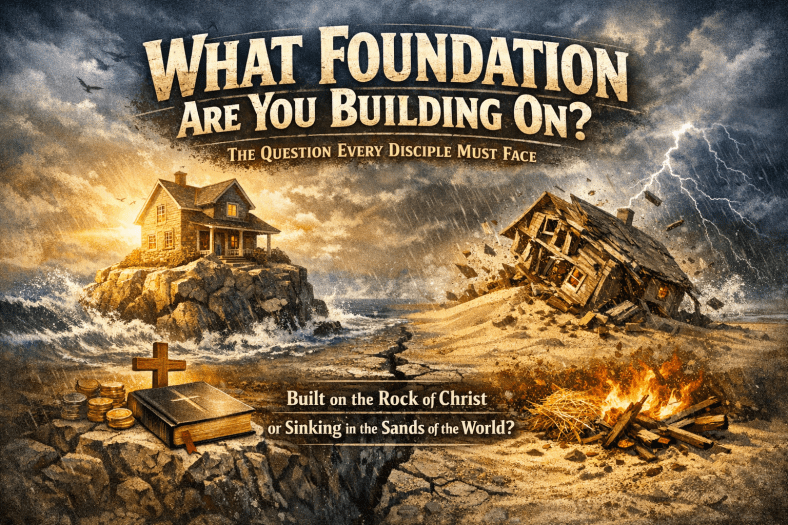
Jesus Himself warned us about the danger of a faith that collapses under pressure. “Everyone who hears these words of Mine and does them is like a wise man who built his house on the rock.” (Matthew 7:24) The storm came, the winds blew, the floods rose—and the house stood because its foundation was not circumstantial. But the house built on sand fell, “and great was its fall.” (Matthew 7:27)

A storm does not create weakness. A storm reveals it.

And perhaps that is what Snowmageddon exposes—not the fragility of our infrastructure, but the fragility of our ecclesiology. A church that closes at the first sign of difficulty has confused the building with the body. A church that cancels worship because the weather is inconvenient has forgotten. It has forgotten that worship is not an event but a life. A church that retreats while the world mobilizes is a church that has lost sight of its calling.

Jesus said, “The harvest is plentiful, but the laborers are few.” (Matthew 9:37) He did not add, “unless it snows.” He did not say, “unless the roads are slick.” He did not suggest that the work of the Kingdom pauses when the forecast is unfavorable. Souls do not stop needing salvation because the temperature drops. Hearts do not stop needing hope because the wind picks up. Darkness does not delay its work because the roads are icy.

If anything, storms heighten the need for light.

The world prepares for the storm because it knows what storms can do. The church should prepare for the storm because it knows what storms reveal.

And maybe that is the quiet message hidden inside this winter’s theatrics. If a snowstorm can cancel our worship, perhaps what we call worship was never the thing God asked for. If a weather system can scatter the saints, perhaps the gathering was never rooted in the Spirit. If the church retreats while the world mobilizes, maybe we have forgotten that the Kingdom work is still work. The One who called us did not limit His commission to clear skies.

“Be steadfast, immovable, always abounding in the work of the Lord.” (1 Corinthians 15:58)

Storm or no storm, the Kingdom does not close. Storm or no storm, the mission does not pause. Storm or no storm, the church is still the church.

And maybe Snowmageddon is not the storm we should fear. Maybe the greater storm is the quiet one. It shows how easily we retreat when the world needs us most.

Take It Slow in the Snow


A Winter Road. A Spiritual Lesson. A Faithful Captain.

Opening

The weather outside may be frightful, and the roads may be anything but delightful. Snow piles up, visibility drops, and ice hides beneath the surface waiting to surprise the unprepared. On days like this, the wise stay home. But if you must venture out, safety is job one.

Take it slow in the snow.
Because where there is snow… there is almost always ice.

1. The Four‑Wheel Drive Myth

A lot of folks hit the winter roads thinking four‑wheel drive makes them invincible. But every seasoned driver knows the truth:

All tires slide on ice.
Four‑wheel drive helps you get moving — it does nothing to help you stop.

And sometimes?
Four‑wheel drive just gets you into trouble faster.

Spiritually, pride works the same way.

1 Corinthians 10:12 — “Let him who thinks he stands take heed lest he fall.”

Overconfidence is black ice for the soul.

2. Weight: The Hidden Stability

Years behind the wheel taught me something most people don’t understand:

An empty truck bed is unstable.
A loaded truck settles down.

Weight increases traction.
Weight presses the tires into the road.
Weight gives you control.

Spiritually, the same is true.

Psalm 119:11 — “Your word I have hidden in my heart, that I might not sin against You.”

A believer with Scripture inside them has spiritual downforce.
An empty soul slides.
A weighted soul stands.

3. Traction: Obedience Under Pressure

Dualies give you more rubber on the road — but only when there’s weight pressing them down.

Empty dualies?
They float on snow.
They lose grip.
They slide sideways.

But load that truck…
and those dualies bite into the surface and hold steady.

Obedience works the same way.

James 1:22 — “Be doers of the word, and not hearers only.”

Traction isn’t about speed — it’s about grip.
It’s about consistency.
It’s about doing what God said even when conditions are slick.

4. Modern Parables from the Road

Parable 1 — The Invisible Ice

Black ice looks like pavement.
Temptation looks like opportunity.

Proverbs 14:12 — “There is a way that seems right to a man, but its end is the way of death.”

Parable 2 — The Slow Driver Who Arrives

The one who slows down in the storm is the one who makes it home.

Isaiah 30:15 — “In returning and rest you shall be saved; in quietness and confidence shall be your strength.”

5. The Road as an Altar — First Person Revelation

I’ve spent a lot of years behind the wheel.
Long roads. Long nights. Long storms.
And if there’s one thing driving has taught me, it’s this:

Experience helps… but experience alone won’t save you.

I’ve learned to feel the road through the steering wheel.
I’ve learned how a truck talks when the bed is empty,
and how it settles down when it’s carrying weight.
I’ve learned the difference between snow and ice,
between a slide I can correct
and a slide that’s already decided for me.

But even with all that experience,
I’ve had moments where the road reminded me:
You don’t know what you don’t know.

And that’s exactly what happened on the Sea of Galilee.

The disciples weren’t rookies.
They were experienced fishermen — men who grew up on that water.
They knew the winds.
They knew the currents.
They knew the storms that came out of nowhere.

But one night, a storm hit that was bigger than their experience.

Mark 4:37 — “And a great windstorm arose, and the waves beat into the boat…”

These seasoned men panicked.
Why?
Because experience can teach you a lot —
but it can’t teach you everything.

Experience can make you skilled —
but it can’t make you sovereign.

Experience can help you navigate storms —
but it can’t calm them.

Only Jesus can do that.

Mark 4:39 — “Then He arose and rebuked the wind, and said to the sea, ‘Peace, be still!’”

And someone always brings up Paul’s shipwreck as a rebuttal —
“See? Even a man of God can go down in a storm.”

But look closer.

The ship wrecked…
but the people didn’t.

Acts 27:22 — “There will be no loss of life among you, but only of the ship.”

Why?
Because a man of God was on board.
Because God had a purpose for Paul that no storm could cancel.
Because Jesus wasn’t just along for the ride —
He was the Captain of the outcome.

And that’s the lesson I’ve learned on the road:

I can have experience.
I can have skill.
I can have traction and weight and wisdom.
But if I try to navigate a storm on experience alone,
I’m headed for a wreck.

But if Jesus is in the cab with me —
better yet, if He’s the One holding the wheel —
then even if the truck slides,
even if the road gets rough,
even if the storm gets violent…

I’m going to make it.

Not because I’m a great driver.
But because He’s a faithful Captain.

Psalm 121:8 — “The LORD shall preserve your going out and your coming in…”

Final Reflection

And before I close this out, let me say one more thing — something personal, something true, something I carry with gratitude every single day:

I’ve survived over three million miles behind the wheel.
Accident‑free.
Incident‑free.
Storms, snow, ice, long nights, empty roads, and crowded highways —
and I’m still here.

Not because I’m the best driver.
Not because I always made the right call.
Not because experience never failed me.

I’m here because Jesus piloted my ship.

Three million miles…
and not one of them driven alone.

Thank You, Jesus.

Closing

If you have nowhere to go today, let it snow.
Rest. Be still.

But if God calls you forward, take it slow in the snow.
Move with wisdom.
Move with awareness.
Move with Him.

Because the One who guides you through the storm
is the same One who clears the road ahead.

Proverbs 3:6 — “In all your ways acknowledge Him, and He shall direct your paths”